The reasoning system
for organizational change
Connect enterprise context, evidence, analysis, and decisions across organizational change
through a structured way of working, with AI supporting faster, higher-quality reasoning.
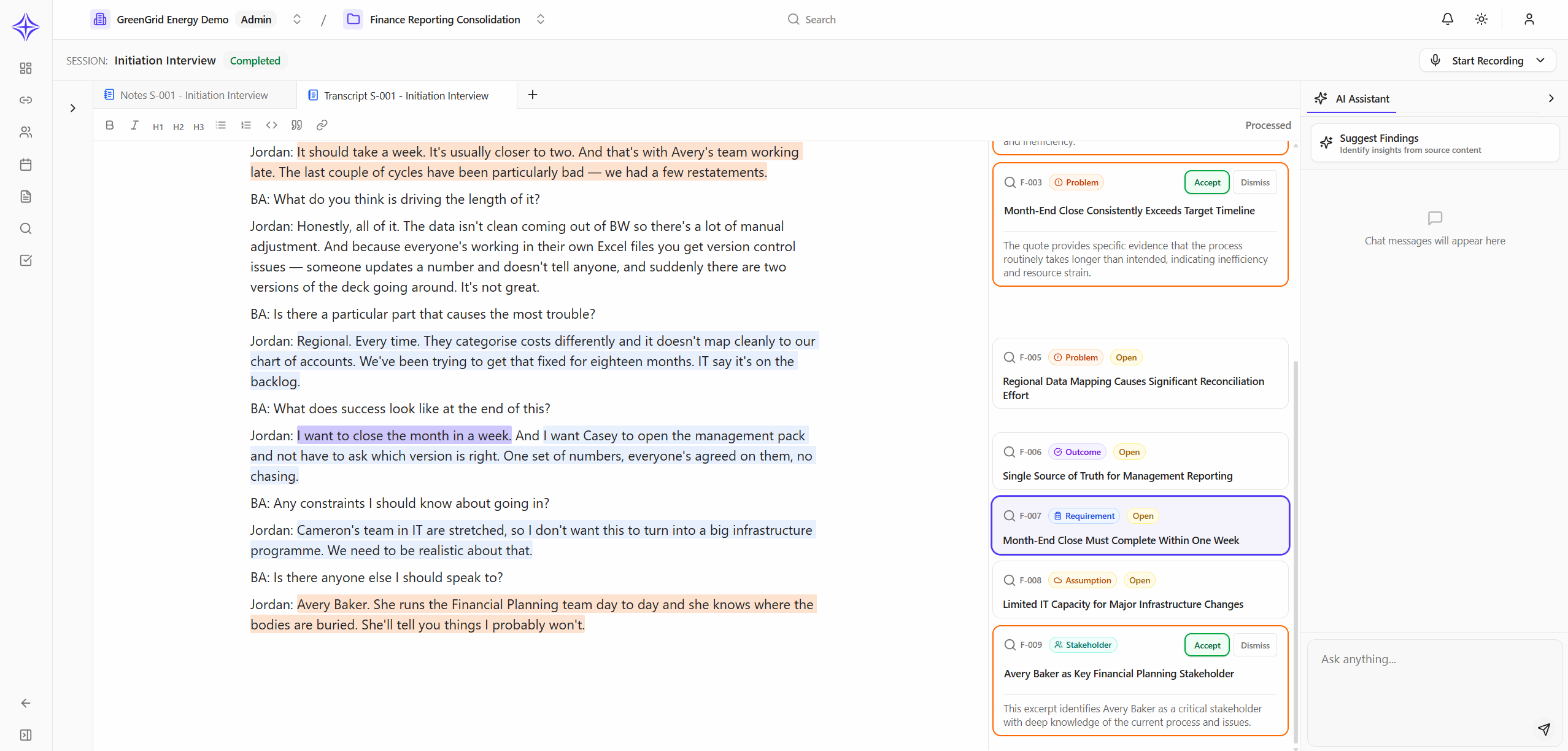
Context, method, and traceability built in.
Enterprise context, structured reasoning, and traceable evidence come together in one system for organizational change.
Enterprise context
Start from the organization you are actually changing. Connect relevant capabilities, processes, departments, systems, data, people, and integrations from the systems that already describe your enterprise. Enterwise brings that context into the analysis so teams can work from a shared understanding instead of rebuilding the current state from scratch.
Structured change method
Enterwise guides analysis through the right structure, sequence, and questions. It checks the quality and completeness of the reasoning, helping teams establish intent before jumping to solutions, explore directions before committing to an approach, and revisit earlier reasoning when new evidence emerges.
Evidence & traceability
Turn sessions, transcripts, documents, notes, and observations into findings that can support, challenge, or extend the reasoning. Enterwise keeps problems, assumptions, requirements, decisions, and other reasoning objects linked to the evidence behind them, so teams can understand where conclusions came from and reconsider them when new information appears.
Version control for organizational change
Start with the relevant enterprise entities as your current state, define the planned changes and target state, then capture the realized state as execution unfolds. Enterwise versions each state and keeps the diffs between them, giving you a traceable record of what change was actually realized.
Divergence: Direct CRM → Verification replaced by middleware. Reason: Exception handling and API constraints required a mediated integration; Customer Success role updated for verification review.
Version branch diagram for a customer onboarding verification change. Current State shows CRM connected to a legacy Verification application, plus Customer Onboarding Process, Customer Success Role, and Customer Entity. Target State retires the legacy application, adds a new Identity Verification Service with a direct CRM connection, and updates the onboarding process and customer entity. Realized State also adds Integration Middleware between CRM and Verification, updates the Customer Success role, and retires the legacy application. Divergence: direct CRM to Verification replaced by middleware. Reason: exception handling and API constraints required a mediated integration; Customer Success role updated for verification review.Bring realized change back into the enterprise
Keeping enterprise information current is often left until after the project, when context has already been lost. Because Enterwise captures the realized change as part of the work, verified updates can be synchronized with authoritative systems or sent to the responsible owners as soon as the change is complete. Each change leaves the enterprise better understood and better prepared for the next one.
Five Change Functions from Intent to Evolution
Built on Intent Integrity, the Change Loop that keeps intended outcomes intact from reasoning through validation and organizational learning.
Function 1
Intent
Establish what outcomes to pursue and why they matter. Intent becomes the reference every later decision is checked against, without prematurely locking a solution.
Function 2
Direction
Determine what should change and how. Deepen Current State where needed, investigate problems and opportunities, compare alternatives, and choose a Direction that stays traceable to Intent.
Function 3
Execution
Realize the chosen Direction. Requirements and decisions travel with delivery. When scope shifts, the divergence is deliberate and documented, not unnoticed drift.
Function 4
Validation
Determine whether intended outcomes were realized. Compare Realized State to Intent; reopen earlier functions when evidence requires it.
Function 5
Evolution
Learn, adapt, and incorporate what the change taught the organization. The next initiative starts with sharper enterprise knowledge.
Bring your next change into Enterwise
Start with the organization, reason from evidence, and keep the change connected from intent to outcome.